The Tweet Smell of Success

by Hector Cisneros

Don't know a twit from a tweet? Do you think Twitter is a waste of time? Or are you wondering why all the
Image representing Twitter as depicted in Crun...
Image via CrunchBase
 media outlets always seem to mention their Twitter accounts? If you don't understand twitter, then this article is for you! In this article I will discuss many of the benefits that Twitter has to offer any business. I will explain why you want to start using Twitter to help grow your business. On top of that, I will also provide links to articles chock full of useful techniques, tools, pitfalls to avoid and shortcuts you can employ to become a successful Twitter marketer.

Tweets Beat Feet

If you are looking to grow your followers in a hurry, Twitter is by far the easiest social network that can accomplish this goal.  In the first place,Twitter has a corporate culture that is reciprocal. By that I mean that people will follow you back if they believe you have similar interests or have something useful to offer. In many cases these followers are absolute strangers who follow you in order for you to follow them. This is in stark contrast to Facebook which is a much more closed garden where you have to be approved to become connected. On Twitter you can follow someone without them following you back. This makes it much easier to attract a large following on Twitter.

Twitter is No Twit

Tweets are search engine friendly. That means they show up in Google Search, where many other social 
Image representing Google Search as depicted i...
Image via CrunchBase
posts do not. Add to this the fact that Twitter allows for push marketing (messages lead readers to a specific URL) as well as  its innate ability to allow you to search for a highly targeted  audiences, and there is more to Twitter than just tweets. Once you start using Twitter you will soon discover that it allows a person to see what is trending (what most people were talking about). This feature allows you to search tweets to target peoples' interests based on what they are saying.  This is one sophisticated social network.

Once you’re a twitter member you can even use twitter search functions to peruse what other subscribers are saying.  This search function can be carried out based on any keyword you would like to include, such as name, location, subject, occupation, industry, tag line etc. This search function can literally be used to cover anything listed in the twitter subscriber's profile.  

In the past being able to know an audience’s demographic information (age, location, income etc.…) was a 
English: The content of tweets on Twitter, bas...
English: The content of tweets on Twitter, based on the data gathered by Pear Analytics in 2009. (Photo credit: Wikipedia)
tremendous benefit for any advertiser. Social networking has advanced this technology by allowing subscribers to search  twitters subscribers psychographic information (personal likes, affiliations, hobbies, interest, favorite shows, books, artist  etc…)  This is extremely powerful and focused way to search for a targeted audience.  

Trick or Tweet?

Once you determine the audience you want to work, the next step is understanding what is and what is not of interest to your audience.  Social networks have a set of unspoken rules of engagement that every networker needs to understand and employ.  Breaching these rules can not only cause you to lose followers, but it can even in some cases cause you to lose your networking privileges.

#1.  It's all about them .  Trying to make it about you won't work unless you’re a celebrity! People don't join Twitter or any other social network except to fulfill something they want.  This usually means  their personal interests, their desired information, and their specific tastes in entertainment or groups they want to connect to. They did not join to see or hear about your advertisements.  If you want people to follow you, be interested in them, be engaging and provide value added useful content.

#2.  Use your grandmother's rules of etiquette to monitor your behavior. Be proactive (be first to help others) be nice, be thankful, be helpful and be courteous. Avoid being short, mean or vulgar. This is a very public and unforgiving  forum. It's extremely hard to take things back!

#3.  Be professional. Understand that people are learning who you are by what you say and how you're saying it. Double check your grammar and spelling. Avoid slang, acronyms, cursing, salacious and derogatory language.

#4.  Provide useful information to a focus targeted audience. Trying to please everyone or to  get everybody to follow you is a waste of time. Target people with mutual interests and constantly provide value added content to win their loyalty.

#5.  Post your information on a regular schedule. Do this preferable once a day at the same time each day . Every audience and interest group has a limit to how many posts they are willing to read each day. If your information is deemed useful, then you can post more often than once a day. Pick a regular time and block out a couple of hours minimum a week to research and make your posts. Make it a fixed calendar item.

#6.  Use tools and techniques' to leverage your time and efforts. Use tools that are approved by twitter. Using unapproved tools can cost you or get you suspended. This includes hash tags, URL shorteners, user management tools (like "JustUnfollow.com")  and aggregating software like Hootsuite and Tweet Deck.  Also don't be afraid to post the same content to other social networks. This is part of creating leverage. You may have to provide some additional format changes but most of your work is already done, so take advantage of the time you have saved.

Below I have included a list of useful articles that can help you become a power user on Twitter.  While Twitter alone is not enough to ensure the growth of your business, learning how to successfully employ it can take your venture one step closer to the sweet smell of success.

Links to other articles and secrets.

Six Cardinal Rules for Success in Social Media Marketing

Six Simple Yet Powerful Rules That Help You Build Your Twitter Flock

Five Powerful Techniques That Attract Twitter Followers

Three Internet Marketing Techniques That Use Leverage To Produce Great Results

Four Principles That Use Leverage to Market Your Business and Produce Powerful Results

Six Clear Reasons why you should be using Social Media to build your Credibility

Trick or Tweet, The vulnerabilities inherent to Twitter and all Social Networks

 The Twelve Secrets of Social Media Success

Seven Secrets of Social Media Magnets

Making Social Media Work for Your Business

What the best Social Media site for a Small Business

Seven Valuable Benefits Social Networks Provide and Social Media Marketers Covet

Social Equity, Businesses use it, here’s how to get some

Social Media and Keeping Up with the Joneses (The Competition!)

How to win friends and influence people in the 21st Ccentury

How to Win Friends and Influence People in the 21st Century - Take Two

Success Secret for Social Media Connecting

Three Common Mistakes Business People Make When Using Social Media


Hector Cisneros is CIO of W Squared Media Group, a Jacksnville-Florida based company dedicated to helping clients succeed online.  You can also interface with Hector every Tuesday at 2 pm during his weekly broadcast of Working the Web to Win on Blog Talk Radio.
Enhanced by Zemanta

How to Make Google Like You

by Carl Weiss

Image representing Google as depicted in Crunc...
Image via CrunchBase
What do you feed an 800-lb gorilla?  Anything he wants.  And if that 800-lb gorilla happens to be the world’s most popular search engine named Google, then boy are you going to need a ton of bananas.  Having worked the web since 1995, I can tell you that I have seen a lot of search engines come and go. (The recent closing of AltaVista being one highly publicized case in point.)  But to date none of them has been big and bad enough to more or less own the Internet.  Then along came Google.  Started in 1998 by Sergey Bryn and Larry Page, the search engine quickly gobbled up market share, particularly after going public in 2004.  Today, Google controls more than 81% of search worldwide.  So if you hope to make a splash online then you are going to have to come to terms with the King Kong of search engines.


He's BIG 

Back in the early days, many SEO experts routinely used to amass position by gaming the search engines.  By that, I mean that they used to routinely try to trick the search engine spiders into rating them highly by the use of underhanded tactics such as keyword stuffing and link farms and all other sorts of nefarious deeds.  However, over time, the spiders have gotten wise to such tactics and today the bots are sophisticated enough to detect most forms of cheating.  Sure, you might get away with gaming the system for a few days, weeks or even months, but catch up with you they will and then there will be hell to pay.  The same goes for any clients of firms who still try to cheat the system.  Those tarred with the same brush can not only expect to lose ranking, but they can wind up being blackballed or even delisted, which means that they will have to start from scratch.

He's Hungry

My advice to those who wish to thrive online is simply this: Give the gorilla what he wants.  Today that 
English: a chart to describe the search engine...
English: a chart to describe the search engine market (Photo credit: Wikipedia)
means content and lots of it.  Gone are the days when you could create a website once every few years and then walk away.  The face of Search Engine Optimization has changed as well.  Before the turn of the century, everything the spiders needed to rank a site was contained on the homepage.  That is no longer the case.  In fact, only 25% of the criteria used to rank a site today is on-site.  The other 75% is off-site.  It is composed of such things as blog posts and social posts, podcasts and videos.  Ranking today is determined by how well the content is crafted and how often it is posted.  That’s right, sports fans; the spiders have learned how to read.  They can tell the difference between an article-length blog and a tweet.  While they can’t comprehend video yet, they can judge such things as length, number of videos on a channel, how often they have been viewed, keywords and comments. 

Another thing about the big guy…He prefers his own brands.  That means if you are going to blog, you want to use Blogger, because Google owns Blogger.  If you want to post videos, then you want to post them on YouTube, because, you got it, Google owns YouTube.  And if you are into social networking, which is an SEO must these days, then you better not leave Google+ out of the mix.  Need I tell you why? 

He's Smart

More importantly, not only do the search engine spiders respect content, so do your prospects and customers.  While many businesspeople lament the fact that crafting weekly blogs, daily social posts and a couple of videos per month take a not insignificant amount of time in an otherwise busy schedule, all I can tell you is that from your audience’s perspective, this is time well spent.  Consumers today are information 
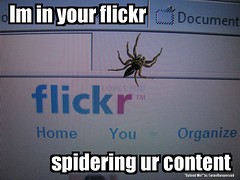
In ur flickr
In ur flickr (Photo credit: TaranRampersad)
junkies.  They prefer being shown as to being told.   They will spend more time checking you and your product line out online than ever before. Why not, since it has become so easy.  Reputation management has become big business do to the simple fact that companies can no longer hide slipshod practices, bloated prices and poor customer service.  Business review sites have sprung up like weeds touting scammers, spammers and take-it-on-the-lammers to anyone who cares to read.  The search engine spiders can also pick up on less than stellar reputations and will not only take appropriate action, they have also been known to hold a grudge.  This means that not only do you have to protect your reputation; in the digital age you are also forced to police your reputation as well.


So if you truly want to make the grade online, you need to take the time to provide quality content on a consistent basis that engages your audience and satisfies both the search engines and your audience.  This means providing multimedia offerings in the form of video and audio as well as the written word.  You also need to make sure your online reputation shines.  Last but not least you need to make the care and feeding of the 800-lb gorilla in the room a priority.  Because if you don’t provide the gorilla with bananas, then all you are likely to see online is goose eggs.  And they won’t help you fill the coffers.

Carl Weiss is president of W Squared Media Group a Jacksonville, Florida firm that specializes in online marketing.  He also owns and operates Jacksonville Video Production.  You can also interface with Carl every Tuesday at 2pm on his Working the Web to Win radio show.
Enhanced by Zemanta

The American Webolution

by Hector Cisneros

With the fourth of July rapidly approaching I thought I'd take some time to talk about how the World Wide Web has changed the face of advertising in this country forever more.  While advertising has evolved over the last 100 years, it wasn't until the advent of the internet that the way in which consumers deal with merchants fundamentally changed. The last 20 years have freed consumers from the trappings of time and space and has allowed them to take charge of what they see, read and consume. The internet has actually empowered consumers to take control of their consuming destiny and it has ushered in the era of consumer control over false advertising and poor customer service.

In the beginning there was media!

The beginning of the 20th century advertising was dominated by print, then radio, followed by TV, junk mail and telemarketing. The last 20 years has seen the rise of the internet as a daily use utility. Its capabilities have changed how we act, think, talk work and play. It has frustrated, overwhelmed, bombarded and forced us to learn new ways of interacting and finally, it has empowered consumers to take charge of how they are sold to.

What changed in the last 20 years?

The last 20 years follows a time that looks like this. The World Wide Web begins in 1993 soon followed by Internet Email and the first Banner Ads starting in 1994. Early models of pay per view and pay per click 
Image representing Google as depicted in Crunc...
Image via CrunchBase
emerged after that, eventually evolving into Google's Adword's model in 2000. Mobile SMS also made their debut followed by POP Up ads in 2001 and blogging (with Adsense ads) in 2003. YouTube was purchased and promoted by Google in 2005; Facebook begins it trek to social media dominance that year also. Mobile Websites (with Adsense) take off in 2007 followed by Online Article (In-Text Ads) and LinkedIn (with on-page ads) in 2008. Mobile apps emerge (with ads) in 2009 followed by Twitter celebrity endorsement advertising in 2010 and Facebook Mobile and Native Advertising (ads that look like content) in 2012.

The collision of technologies elevates the value of time and choice!

During the last 20 years, the escalation of new knowledge, new technologies, instant access to news, various media content and the bombardment of internet related advertising has caused content overload. This has made the use of our time very precious. The advent of time shifting of broadcast media, our ability to preview solicitation via caller ID and email previewing along with anti-spam filtering have allowed us to make choices of how we use our time. The advent of social networking has allowed us to connect with friends, family and other like minded users in order to share our thoughts, likes and dislikes. Consumer choice and our new found ability to network and share our experiences have ushered in the story telling and sharing era that is empowering consumers. Now consumers have a powerful weapon against poor customer service, and can spread positive and negative recommendations so fast that it can turn a deceitful marketer's stomach.

What can an advertiser do to make consumers happy and please their vendors

So what is a business to do? How can they reach their target market and get their message out about their wonderful products or services? Well for one, advertisers need to start by telling the truth about their products or services. Gone are the days where an advertiser could use fluffy language, hyperbole or outright lies to sell their products. You can fool a few people today, but the truth now gets out so fast that inferior products and poor customer service are exposed quickly and the consuming public is not quick to forgive these transgressions. Second they can provide added value with their products. The internet allows vendors to provide many types of added value to their customer base. They can provide useful, interesting, and entertaining content via free eBooks, picture galleries, and additional meaningful information. They can provide inducements via discount coupons, exclusive offers, recognition and other creative value ad features that the internet can easily deliver. In other words give consumers what they want, including honesty, integrity and a good value for their money and you will not have any problem doing business online.

There is another piece to this puzzle and that is pleasing the people in charge of the internet. You know who I am talking about; Google, Facebook, Yahoo, Twitter, LinkedIn, and all the other big internet media players. 
English: www,domain,internet,web,net
English: www,domain,internet,web,net (Photo credit: Wikipedia)
If you want to succeed online today you need to give these players what they want. Gone are the days that black hat tricks will put you on top of the search engines in thirty days or less.  The rules for success in social media are also a moving target, so tricks will only work for a short time here also. Today a marketer needs to learn, follow and keep up with an ever changing set of marketing rules just to get found.  So what are the rules of this marketing game? What are the guidelines to success? Is there a magic formula for getting results?

The magic formula for making consumers happy!

Here are a set of rules that when followed closely lead to marketing success.

      1.      You have to provide a useful product or service.  Hype will no longer sustain sales for very long.

      2.      Provide quality products and superior service to your clients. Clients talk about you whether you like it or not! Give them something good to say. Better yet ask them to say good things about you.

      3.      If you are marketing in search (who isn't) you need to give Google what it wants. Google feels that people want quality, truthful and accurate content about your product or service. Google feels that people vote by recommending you, by connecting with your internet properties (liking, following, etc..) and people vote by sharing your message (whether it’s a blog post,  tweet, URL or coupon). Google also assume that negative votes (poor reviews and bad testimonials) should count against you. Google employs its secret and proprietary algorithm to assess your internet property’s popularity which results in your keyword ranking. Google also likes you to provide a wide variety of useful content. A good way to start is to provide lots of multimedia posts. Provide lots of quality videos, podcasts, blog posts, pictures, articles and social posts to begin with. On top of this the posts have to be seen and shared by lots of people. This means you have to develop a strong social network with a substantial number of followers. Otherwise your information will not get viewed, read, played, commented on or shared. Having good quality content is the start, getting play is the goal. Having content that is being used, commented on and shared gets you recognized and improves ranking.

      4.      The last piece to the puzzle is consistency. You have to provide content on a regular (i.e. weekly) basis. Some mediums require daily content. And you have to consistently invite people to follow you so that your social networks grow. Follow these general rules and you will be 50 percent closer to your goal. The last 50 percent requires testing, measuring and adapting to market conditions. Being found is only half the battle. Providing a compelling message that closes the deal is the second part that must be discovered through diligent testing and measuring.

While it is uncertain what the next twenty years will bring one thing is certain.  Never in the history of advertising have consumers help so much sway over the merchants from which they buy.  The very concept of  dominance via online public opinion isn't only unprecedented, it is webolutionary.  Have a happy and safe fourth of July.

Hector Cisneros is COO and social media director for WSquared Media Group. Connect with him on TwitterFacebookGoogle+, and YouTube. W Squared Media Group is based in Jacksonville, FL. He is also co-host of Blog Talk Radio’s “Working the Web to Win,” where he and Carl make Working the Web to Win simple for every business. Hector is a syndicated writer and published author of two books, including 60 Seconds to success and Century which you can get free by clicking on the link.


Enhanced by Zemanta

World Wide Weird

By Carl Weiss

Listen to internet radio with workingthewebtowin on BlogTalkRadio
Who would have thought when Robert Noyce invented and patented the silicon based integrated circuit way 
English: Microchips (EPROM memory) with a tran...
English: Microchips (EPROM memory) with a transparent window, showing the integrated circuit inside. Note the fine silver-colored wires that connect the integrated circuit to the pins of the package. The window allows the memory contents of the chip to be erased, by exposure to strong ultraviolet light in an eraser device. Uploaded by Richard Wheeler (Zephyris) 2007. (Photo credit: Wikipedia)
 back in 1959 that the world would forever more be changed.  While the initial uses for the computer chip were initially limited to big business and military applications, within a dozen years, the computer revolution would enter consumer electronics with the founding of Apple Computer.  Since then the integrated circuit has become part of virtually every consumer electronic gadget from cellphones and televisions to the cars we drive.  Just when you think that just about every possible application has been thought up, some enterprising entrepreneur comes up with another use for the computer chip.  While there are a number of useful creations such as medical prosthetics that have been known to improve the quality of life for many, what I want to bring to you today are the “out there” applications that seem to be some sort of technological outgrowth of the lunatic fringe.

Two Delicious Drones

While aerial drones are nothing new, there are at least two engineers are planning on using them to make the term “to go” mean entirely something new.  The Burrito Bomber is the brainchild of Yoni De Beule and John Bolles.  The pair used a 3-D printer to create their own custom-made bomber that is designed to carry and air drop burritos via parachute.  (I am not making this up.)  The aircraft is directed to its destination via GPS and can be operated either autonomously or via remote control. 

What’s even more alarming about this development is that the Burrito Bomber isn’t the only flying fast food to hit the scene.  In a much publicized YouTube video, Domino’s Pizza demonstrated the DomiCopter making an aerial pizza delivery in the UK.

Sadly, anyone hoping for an aerial munchies fix will have to keep hoping for a while. The Burrito Bomber is currently just a prototype.  Current Federal Aviation Administration regulations prohibit commercial use of unmanned aircraft, but that could change.  "Pending regulations from the FAA in 2015, we'll be able to drop a burrito to a neighborhood near you," says Boiles.

RoboRoach

This might not be the best segway in the world, going from food to bugs, but here is another outlandish example of what can be done with a computer chip and way too much time on your hands.  While many people consider cockroaches a nuisance that should be eradicated at all cost there are at least two PhDs that think otherwise.  Backyard Brains co-founders Greg Gage and Tim Marzullo both have doctorates in neural engineering.  Where most of their colleagues use their education to discover ways to connect human beings to electronic devices such as prosthetic limbs, cochlear implants and the like, Gage and Marzullo decided to pursue an entirely different career path.  They decided to form a company dedicated to inspiring scientific curiosity.


The company, established in 2009, sells low-cost kits to turn any and all interested amateurs into neuroscientists. (The company's bread-and-butter product is the SpikerBox, an electrophysiological contraption that allows you to record the brains of insects in real time.) And the RoboRoach, according to the creators, employs the same neuraltechnology used in treatments for Parkinson's as well as the make-up in cochlear implants. Now, to be clear, the RoboRoach is not the answer to the diseases; but it's meant to be a font of inspiration.

I won’t tell you what is required to robotize a roach, since it makes me queasy just to think about it.  But fret not, because the guys from Backyard Brains have created a step-by-step video that will take you through the medical procedure should you be so inclined. Can you say ewwww?” http://youtu.be/5Rp4V3Sj5jE

BugBots to the Rescue

If robotic Roaches weren’t weird enough, there are several universities currently pursuing insect inspired robots that scuttle, slither and fly. 

In a team led by graduate students Kevin Ma and Pakpong Chirarattananon, Harvard Microrobotics Laboratory has created tiny, housefly-sized robots for the purpose of studying insect flight.  Small flying insects like flies are capable of extremely agile maneuvers, such as dodging out of the way of an incoming fly swatter, or landing on flowers and grass that are moving in the wind — making their flight difficult to replicate in a laboratory condition. But by using some unconventional approaches to propulsion, manufacturing and actuation, the Harvard Microbiotics team — after a decade's work — has been able to create a robot that can hover on the spot, take off vertically and steer. They're called RoboBees.  
Currently used as a flight demonstration system due in part to the fact that the RoboBees need to be tethered to an off-board power source, the design team looks forward to the day when their robotic insects can take wing on their own for everything from crop pollination to search and rescue missions. 
Not to be outdone, other researchers at   Harvard Microrobotics have come up with the Harvard Ambulatory Micro Robot, otherwise known as the HAMR.  Utilizing the same fabrication process used to create the RoboBee, the HAMR weighs in at just 1.3 grams and while they can’t fly, they can scuttle along at 37 centimeters per second.  While the developers of the HAMR have as of yet to come up with an actual use for the tiny robots, the researchers claim that they are cool to have around.  

What’s Next?
While a quick search of Google and Kickstarter is a good way to get a bead on the far out uses of the microchip, only time and imagination will show what wondrous and wacky inventions will be spawned next from a sliver of silicon.  (Personally, I think there is soon going to be a pressing need for an autonomous flyswatter that is designed to combat the coming onslaught of bugbots.)


Carl Weiss is president of W Squared Media Group, a company that helps entrepreneurs develop their products by offering an array of funding, design and marketing services.  You can also hear about some of the other weird, wonderful and wacky inventions that the integrated circuit has wrought on Carl’s Working the Web to Win radio show live at 4 pm Eastern today.
Enhanced by Zemanta

Is SEO Still Relevant NOW?

by Carl Weiss

Ever since the inception of the internet, search engine optimization, otherwise known as SEO, has been bandied about as if it were the holy grail of online success. But what is SEO really? Is it simply optimizing your website? Or, has it grown to include  posts to all your web properties?  My answer to these questions may surprise you. SEO is no longer just one thing. It has grown to mean so much more. In this article I will discuss how search engine optimization has evolved in order to become Search Engine Marketing (aka S.E.M.). I will discuss how what was once a single faceted injection has evolved into a multifaceted process. In this article you will find information that will show you how you can improve your search ranking.  This includes specific methods to follow that will insure a strong ranking position. Best of all, you can accomplish all this without resorting to tricks, gimmicks or deception that attempts to bypass the search engine ranking system.

Stop Acting Like it's 1999

Before the turn of the century, achieving search ranking was relatively simple. You selected a keyword  
What really is Search Engine Optimization?
What really is Search Engine Optimization? (Photo credit: Go Local Search)
relevant to your business, created a website, and added the desired keywords to your content. Then you made sure you included Meta and Alt tags and you posted your web pages to the top 100 search engines and directories. Voila.  If you chose your keywords carefully, you soon showed up on page one of Yahoo, AltaVista, Net Taxi and other search engines.

Today it isn't so simple.  The major search engines, such as Google, Yahoo and Bing are mostly concerned with quality content, delivered on a regular and timely basis. This content needs to be diversified (web pages, blogs, social media, videos etc…) and it needs to be highly relevant to the keyword or phrase that is being searched. Today if you meet these criteria you will do well in organic search, (assuming your competition is not better at it than you).  If you ignore these items then your chances of showing up on page one are slim at best.

Is On-Site Optimization Dead?

I am often asked is web page optimization still important? My answer is yes. Google and all other search engines care about properly formatted Meta and alt tags. Although this only accounts for a small portion of the overall score, it is still very important. If this on-page information is incorrect, missing, or doesn’t match the content, search engines will either ignore or misinterpret your content and  rank you low or not at all. Either way it means bad news for your website. Make sure your on-page Meta and Alt tags are formatted to match the content and keywords.  Otherwise your quest to be on page one will end before it begins.

Is SEM Different than SEO?

Search Engine Marketing is a much  comprehensive than Search Engine Optimization. It includes all your websites plus  your blog posts, social network posts, any PR posts, all pod casts and video posts.  In essence, S.E.M. encompasses all web postings of any kind. Yet it also means more than this. S.E.M. is also a methodology designed to meet the search content requirements that provide high ranking. In other words, your methodology is predicated on doing what the search engines want, not trying to trick them into giving you better ranking. Today it means giving Google what it wants since Google comprises about 81% of all search activity.

What Does Google Want?

Google loves mixed media, which includes video, photos, podcasts, and more.  The reason they do this is 
Image representing Google as depicted in Crunc...
Image via CrunchBase
due to the fact that Google is looking to determine who is serving the public the best content for any specific search. The googlebots evaluate your content for relevancy, usefulness, quality, consistency, timeliness, connectedness, positive feedback and diversity of format (web pages, blogs, social media, videos etc…).  These are very busy bots.

Game the System at Your Own Peril

Gone are the days when you could easily trick the search engines in order to get a high ranking. Google has employed a multi-tier approach to detect most trickery. Their new algorithms penalize such practices as  keyword stuffing, duplicate sites, backlink farms and many other patently deceptive practices. On top of that they have hired a hoard of website evaluators that actually check out your pages, posts and back links. If Google catches you cheating they will downgrade your ranking or remove you from search altogether . Cheating Google no long means just a slap on the wrist. It can mean banishment!

How Can Content Marketing Help You Gain the High Ground?

A decade ago posting a properly optimized website was all it took to achieve ranking. Today's internet audience is far more savvy and sophisticated. Today's websurfers prefer video and photos to text,  provided they can find it. If you have a video on page one above the fold, it is the most likely to be clicked on. We know that statistically, videos will receive 80% of all clicks if they are highly visible. However, videos are not the be all end all. Blog posts can also garner strong position in Google rankings. The same is true for social media posts that that have a high sharing factor (gone viral). Google also loves web pages that receive lots of positive ratings (especially Google Local or Map pages with Google +1 ratings and four or more stars)

The bottom line is that while SEO is not dead, it has changed so radically in the past few years that the rules of the game have changed.  If you want to win, you need to adjust your approach and start creating compelling content that both the search engine bots and the public want to view.  

Carl Weiss is president of W Squared Media Group, a Jacksonville, Florida firm that specializes in helping clients achieve online results.  You can hear Carl every Tuesday at 4 pm when he co-hosts Working the Web to Win on Blog Talk Radio.


Enhanced by Zemanta

Can You Still Make Money Online?

By Carl Weiss

The concept of making money online is nothing new.  It’s what drove most of us onto the internet in the first place.  Back in the good old days before Google more or less monopolized search, there were real opportunities to grab the top slots on a number of search engines (some in as little as 24 hours), create an ecommerce site and get to it.  However, the game has changed to the point where there are now more than 300 million websites online with 130,000 new sites being spawned daily.  And they all want to be on page one of Google. 

While you can buy your way into the game with Pay-Per-Click campaigns, many people quickly find out that
Image representing Google as depicted in Crunc...
Image via CrunchBase
 in many cases generating a click doesn’t mean generating a sale.  As a result you can blow through your advertising budget on any number of search engines, social networks and video portals without turning a profit.  That’s the bad news.  The good news is that there’s more than one way to skin a search engine. 

Non-Traditional routes to Google Page 1

Websites aren’t the only thing displayed on page one of the world’s most popular search engine.  Videos, blog posts and social posts can also find their way onto the first page to those who know how.  Just as with websites, mixed media can also be optimized, particularly if you employ other Google properties to display your media. 

Got a video?  YouTube is owned by Google.  When you do a search on Google more often than not you 
Image representing YouTube as depicted in Crun...
Image via CrunchBase
will find a YouTube cel on page one.  The cel leads to a YouTube video that has been optimized for Google.  While the googlebots can’t view your video, they can see the title, text, backlinks and keywords that wrap the video.  Savvy marketers have been using this for years to jump from YouTube to Google.  Better still is the fact that there will only be one or two videos on any given page and this could actually be more advantageous than having your website on the same page. 

Blogger is Google’s free blogging portal.  Just as with YouTube, properly optimized blogs can and sometimes do get placed on page one of Google.  Just as with video, the post and title need to be optimized so the bots will deem your post worthy of inclusion on page one.  It also doesn’t hurt to get your friends and family to read, comment on and repost your blog posts. 

Then there’s social networks.  While Facebook is currently the world’s most popular social network on the planet, Google+ is the only one owned and operated by guess who?  While some people have referred to G+ as a virtual ghost town, a number of savvy online marketers have used Google’s social network to leverage page one results. 

Is Being on Page 1 Enough to Insure Financial Success?

Sorry to say it but being on page one, even at the top of the page is not enough to insure success online.  It’s only a starting point.  Due to the fact that there are hundreds of millions of sites, people have become kind of jaded online.  That is to say that unlike a few years ago, most people are not going to take the time to click around your 32 page website to decide whether they should do business with you.  In fact, statistically speaking, you only have on average two minutes to dangle the bait and reel in the fish.  And if your offer isn’t all that appealing, then your results are not going to be anything to write home about.

This is why they call it online marketing.  Once you have satisfied the online side of the equation by generating a highly visible link on a search term that contains a great deal of traffic targeted to your product or service, then it’s time to put on your marketing hat.  More experienced internet marketers won’t even start a campaign until they have tested keywords, offers and results via some sort of pay-per-click campaign.  Spending a few hundred bucks to make sure you are going to succeed before spending months to generate organic results isn’t just a good idea.  It’s the only way to go if you are looking to convert cash to clicks.  It is also the best way to adjust your site’s look, feel and offer to maximize your return.

All too many people still subscribe to the Field of Dreams form of online marketing.  You know, “Build it and they will come.”  While they may come, that doesn’t mean that they will buy.  If they don’t buy, don’t blame the medium, whether search engine, social network or video portal.  Blame your offer.  Unless you have an exclusive way to solve a problem or save people money, this means that there is competition.  Competition is easy to find online, Google it. 

Before you start spending time and money constructing a website, shooting video or blogging, you need to see what the competition is offering for similar products or services.  If your product or service costs more and offers less, guess what? You had better start rethinking your concept for a successful launch.  This doesn’t mean that you have to give away the farm to bag sales online.  But you definitely have to offer at least a perceived value that is of equal or greater value than the competition.  As an example, a friend of mine ran a highly successful site for a number of years that sold plants.  The way he beat the competition was not by offering the lowest prices.  Instead he offered the longest guarantee that stated that if his plant died up to two years after purchase he would replace it at no charge.   He told me that less than one percent of his customers ever took him up on this offer.  As a result he was able to sell five figures worth of plants month in and month out.

Partners in Crime

A number of other successful online merchants have found online gold by partnering up with EBay and/or 

Amazon.  Especially if your business is retail in nature, either of these two mammoth online sites can give you quick access to a huge user base and simplified ecommerce solutions that are tailor made to jump you from retail to etail in a hurry.  That doesn’t mean that these portals are the best or indeed the only way to get into the game, since they both charge fees for promoting and/or selling your products.  But they are another way to buy into the game.

While there are no guarantees that your online store will make money in the short run, it will most definitely burn less money than a brick and mortar store, since you won’t have to hire more employees, invest in expensive displays and signage, or worry about the landlord doubling the rent.  The bottom line is that if you are serious about breaking out of your local market and selling nationwide, you need to be prepared to spend the time and money to test the water, build your brand and be realistic about your results as you build your online store.  If you can work out the bugs and find a way to turn browsers into buyers, you could find yourself wondering why you didn’t think of this concept years before.

Carl Weiss is president of W Squared Media Group a business that specializes in helping businesses go global.  You can hear Carl live every Tuesday at 4pm Eastern on Working the Web to Win.


Enhanced by Zemanta

Can Crowdfunding Change Your Life?

By Carl Weiss

Back in the bad old days, entrepreneurs searching for funding had three choices:
1. Friends and Family
2. Banks
3. Angel and Venture Capitalists
Image representing Prosper as depicted in Crun...
Image via CrunchBase
For many this meant that starting a business was nearly a mission impossible.  Then in 2007, all that changed when Prosper.com launched the first peer-to-peer lending service in the US.  Since that time a number of other crowdfunding sites have popped up, including Kickstarter, which in 2012 raised more than $10 million for the Pebble Watch.
Before you decide to quit your day job, understand that not all projects get funded.  Some pitches are flawed, while others are deemed unfundable due to the rules of various crowdsourcing portals.  But for a staggering number of well thought out and executed proposals, the world wide web can your oyster when it comes to jumpstarting a business.  However, as you will soon find out, crowdfunding comes in a number of different flavors. 
Microloans a Big Deal to Start Ups
Prosper is America's first microloan marketplace, with more than 1.6 million members and over $400,000,000 in funded loans.  While few banks will offer loans to start ups, sites like prosper connect with the public to form a funding pipeline that offers loans between $2,000 and $25,000 to businesses.  Individuals can invest as little as $25 per selected business.  Both Prosper and the public profit from these microloans and Prosper discloses credit scores and histories as well as servicing the loan on behalf of the matched borrowers and lenders.  You can even invest your IRA funds in Prosper.
While prosper started the microloan revolution here in the US, they are far from alone.  Other microloan sites have sprung up, with names like captap.com, kiva.com, as well as federal (the SBA has a microloan program) and municipal lenders, such as Los Angeles’ microloan.org run under the auspices of the Valley Economic Development Center.  Just like traditional “loans,” microloans require that the borrower pay back the amount borrowed plus interest. 
The Real Gamechanger
Kickstarter.com on the other hand isn’t based on the concept of the microloan.  This means that 
kickstarter logo
kickstarter logo (Photo credit: AslanMedia)
once funded, project creators are not required to pay back the amount raised.  Other than a consideration that can range anywhere from a thank you to actual merchandise, Kickstarter backers do not expect to receive any other compensation.   Sounds great from the creator’s viewpoint, doesn’t it?  But there are a few caveats:
1.       Everything on Kickstarter must be a project. A project has a clear goal, like making an album, a book, or a work of art. A project will eventually be completed, and something will be produced by it.
2.       Kickstarter does not allow charity, cause, or "fund my life" projects. 
3.      Kickstarter cannot be used to fund e-commerce, business, and social networking websites or apps.
4.      Kickstarter cannot be used to buy real estate.
5.      No contests, raffles, coupons, or lifetime memberships.
6.      No bath, beauty, and cosmetic products; electronic surveillance equipment; eyewear (sunglasses, prescription glasses, and others); firearms, weapons, knives, weapon accessories, and replicas of weapons; medical, health, safety, and personal care products; or infomercial-type products.
More importantly. Funding is an all-or-nothing proposition on Kickstarter.  What this means is that if you set your goal at $50,000 and raise $49,999 you get nothing.  On the other hand, if you set the goal at $10,000 and raise $100,000 you get to keep it all.  What Kickstarter gets out of the proposition is 5% of the money raised by successful creators.  Payment is processed via Amazon Payments in the US, from which an additional 3-5% in processing fees is collected.
So how effective has Kickstarter been?  Since its launch on April 26, 2009, over a half billion dollars has been raised from more than 3 million individuals which was used to fund more than 35,000 projects.  Furthermore, Kickstarter states that of the projects that have reached 20% of their funding goal, 82% were successfully funded. Of the projects that have reached 60% of their funding goal, 98% were successfully funded.
In 2012, crowdfunding totaled $2.7 billion.  This year it is quite possible that those numbers will double.  The
Business
Business (Photo credits: www.roadtrafficsigns.com)
reason that this phenomenon is so popular is due to the fact that it turns funding on its head.  Where in the past entrepreneurs had to go hat in hand from one institution to the next begging those with deep pockets to fund their project.  With crowdfunding, instead of trying to raise $50,000 from a bank or angel investor, it is now possible to raise the same amount of money from thousands of sources a few dollars at a time.  It’s all about being able to wow the crowd.
Creating a successful proposal isn’t like writing a business plan.  Funders aren’t going to pore over your projections.  They want to see what you are bringing to the world and how capable you are of running your company.  Therefore you will need to provide drawings, videos and even animation that show what your product does and why it should be funded.  The best way to get a bead on what works is to peruse Kickstarter, Indiegogo and RocketHub, along with other crowdfunding sites to review projects that have been funded.
What is considered fundable?  Everything from music cds to inventions, games, medical devices, and publishing houses have been funded.  There are even several space-based projects currently being shopped around, including a moon-base and a space telescope.  So with the number of crowdfunding sites growing by leaps and bounds, this is now literally an industry where the sky is the limit.
Carl Weiss is president of W Squared Media Group, an online marketing company that helps businesses prosper online.  You can hear Carl live every Tuesday at 2 pm Eastern on Working the Web to Win.


Enhanced by Zemanta