Getting Your Fiver's Worth


By Carl Weiss

Like it or not, the way we Americans do business has changed a great deal in the past few years.  Whether big business or small, outsourcing and freelancing are the name of the game today.  So much so that a number of enterprising entrepreneurs have devised online portals that specifically cater to this stock in trade.  While some people lament a lack of quality control or even a failure to communicate (due to language differences) with these far flung resources, the fact is that these services are in ever greater demand as business owners strive to tighten their belts in current economic conditions.  So if you have been thinking about giving online outsourcing a go, below is a list of some of the more prominent resources.

Fiverr.com

Have a need, find a gig.  Fiverr.com for those new to the site, allows freelancers to post tasks for hire (called
Image representing Fiverr as depicted in Crunc...
Image via CrunchBase
 gigs) that if purchased by an individual will be accomplished for just five dollars.  Recent gigs have included such things as royalty free music creation, life coaching sessions, copywriting, proofreading, video testimonials, flyer distribution, web starter kits and more.  The site even offers a dozen categories that make finding the right gig for you a snap.  Just don’t expect Hollywood special effects in a video that costs five bucks.  Still some of the work turned out by gigsters can help you build your business for pennies on the dollar.  The best way to understand the ins and outs of Fiverr is to go to Youtube and watch the many helpful tutorial videos.  They costs you nothing and are designed to make sure you get your fiver’s worth.

Tenbux.com

Needless to say, with the success of Fiverr, other sites have popped up to fill the micro job vacuum.  Like fiverr.com, these sites promote offers from freelancers looking to accomplish simple online tasks for a small fee.  However, unlike Fiverr, these sites allow their members to post gigs that range from $5 to as much as $50.  Sporting such monikers as tenbux.com, gigbuckx.com, taskarmy.com and fiftytown.com, the pricing structure is agreeable, as is the army of freelancers ready, willing and able to get the job done quickly and cheaply.  There’s even a site called fourerr.com that posts tasks for hire for only $4 a pop.  You’ve got to love that competitive spirit.

eLance.com and Odesk.com

As they say, you only get what you pay for.  While sites like Fiverr can be of use some of the time, when you want to shop a serious project around, there are other online resources that offer to help.  Two such sites are
English: Worldwide Offshoring Business Deutsch...
English: Worldwide Offshoring Business Deutsch: Weltweites Offshoring Business (Photo credit: Wikipedia)
 elance.com and odesk.com.   Known as peer-to-peer job sites, the way they work is by helping business owners to hook up with talent needed to take on more complex projects.  While Elance started off as a site touting programming and other technical skills, they have since broadened their offerings to include everything from accounting to architecture, marketing and legal services. Odesk offers many skill sets as well, including technical, writing, translation, sales, marketing and customer service.  Both function as a kind of online temp agency, allowing employers to contract with one or several dozen providers at a time.  Unlike hiring “employees,” these resources allow businesses to work with talented and experienced professionals on a per-project basis.  When the job is complete, you can cut the cord and move on without having to deal with firer’s remorse or unemployment benefits. 

According to Elance data, the number of professionals using their hub to find freelance/remote work opportunities increased 52% over the past year, with hiring by businesses using Elance increasing 60%. Businesses, by the way, report hiring freelancers is faster - taking about 3 days compared to the 20+ days it takes to hire a full-time employee.

The real dilemma for many entrepreneurs is the fact that there are now so many different ways to outsource a project that it’s a case of trying to tell the players without a scorecard.  To help you make sense of the many nuances involved in the outsourcing process several resources devoted to the genre are available, including the International Association of OutsourcingProfessionals, Outsource Magazine, Professional Outsourcing Magazine, HROToday, Medical Project Outsourcing, and Sourcing Speak just to name a few.
     

Whether you are looking to outsource tasks, projects or entire departments, either domestically or internationally, there are organizations dedicated to helping you get the right people for the job.  From a business owner’s perspective, outsourcing is no longer the question, it is many times the only affordable answer to staying competitive.

Carl Weiss is president of WSquared Media Group, a company dedicated to helping clients compete online.  You can interface with Carl every week at 4 pm Eastern when he co-hosts Working the Web to Win on Blog Talk Radio.

Enhanced by Zemanta

Are You Socially Acceptable Online?

by Hector Cisneros


Several years ago I heard about this great new network that was going to eliminate the need for going to network meetings.  I decided to join that network to see what all the hubbub was all about. This was the beginning of my association with  LinkedIn. A year later I also joined Facebook and then followed that up 
Image representing LinkedIn as depicted in Cru...
Image via CrunchBase
by joining Twitter. Later I also joined FourSquare, Stumbleupon, YouTube, Ecademy, MerchantCircland Google+ (just to name a few). I soon learned that using social networks was very different than most forms of online marketing. I quickly realized that social networking was very much like face to face networking. Both were a form of word of mouth marketing. Both had fairly ridged rules of how you could build credibility, specific rules that would endear you to followers and rules that would get you un-followed or un-friended very quickly.

Back then, I was looking to come up with a set of social networking rules that would be considered universal. A set of principles, if you will, that would guide a social networker through the ever changing landscape of social networks. Granted, I had been using similar principles to work a number of live networking groups. I had learned these principles over more than 30 years of  business experience. I found many of these principles as a member of various networking Groups like BNI.  I even penned a book called "60-Seconds to Success" that detailed the ABC's of using a 60-second elevator pitch to create a referral network through such groups.   

In 2010 I had a big revelation. I discovered that a lot I the principles that worked for me in Social networking were the same principles that I had written about in my book in 2009. So, I set out to see if all the principles I had learned in face to face networks would apply to online social networking. I quickly discovered that there were many overlaps with only subtle differences. I also discovered that these two different forms of networking could complement each other. Since then I have complied 12 rules, (actually a baker’s dozen) that act as guidelines both in social networks and face to face networking. This article explores these principles and lays them out for you to learn and use. These 12 secrets will allow you to grow your following and build your credibility. Doing so will increase sales and make your social networking easier. So let's get started.

                                              The 12 Secrets of Social Media Success
1.    No one likes to watch commercials. People join social nets to connect with friends, find interesting facts, be entertained and to share information like documents, photos and videos.  At the same time, however they are giving up a lot of personal information. This information is in turn used to target them with advertising messages. To reach these prospects, provide targeted and useful information that fulfills their wants. Rarely post subtle commercials. Any commercial had better provide useful benefits like discounts, coupons or free access to other useful material. Overselling is a fast way to get blocked and unfriended.
 2.    Social networks are some of the best word-of-mouth marketing mediums. Testimonials and referrals are powerful and viral in this medium for getting your message out. If you can get your customers to sing your praises, you will do well. Every testimonial can be used many times. They can be used in multiple networks and be introduced in multiple ways. Also once posted in a testimonial album, they can become focal points where you can send prospects who need reassurance. They can also be used in ads via pay per click. These ads can be very powerful. This is especially true if you incorporate testimonials from that specific social network in that network’s ad space.
 3.    Is Social Networking Free?  Not when you consider the amount of time and effort to setup a social network profile. Multiply this times the top five networks and you can see why you could spend a significant amount of time getting setup.  However, this is only the beginning. You now have to provide useful, relevant and timely content to build your audience. Researching this type of content takes time and posting it also takes time. In any endeavor time equals money. This is why social media is used by so many startup businesses. They have more time than they have money. However once you reach the stage that you have revenue coming in (cash flow), it makes sense to outsource this because it takes a lot of time and thus you would be losing money because this will take away from production and sales.
This is icon for social networking website. Th...
This is icon for social networking website. This is part of Open Icon Library's webpage icon package. (Photo credit: Wikipedia)
 4.    Social Networks are not private. You also give up a significant amount of your privacy. For some this is a heavy price, for others it’s worth getting the infrastructure for networking without having to pay a monthly subscription fee. Having said that, understand that social networks are frequently perused by criminals fishing for unsuspecting victims to defraud them or steal their identity. Make sure you never provide financial information, passwords or too much information that could allow a criminal to guess your password. Purchase Life Lock or another ID protection plan and be vigilant and suspicious of what people are asking for.
 5.    Followers need your attention in two ways: The ones you want to keep need one type of attention and those you want to get rid of need another. Once you start having followers you will need to manage them. Thanking, engaging followers and answering their questions takes time. You will also have to manage who is following you. Removing undesirable followers is a maintenance chore that must be done on a regular basis. You don't have to follow everyone and you don't have to accept everyone who wants to follow you. You will have to walk a fine line between being tolerant and selective
 6.    Like plants, social networks won’t grow on their own! To build a large social network you will have to actively invite people to follow you. Most people underestimate the time it takes to build a following of customers and prospects. A network of a few hundred people is not that useful. To play a significant role you need 1000 plus followers. This cannot be reached overnight. However, you can easily reach 1000 followers by inviting 10 people a day and converting this effort to 4 new followers each day. By the end of the year you will have over 1400 follower as fans.
 7.    Subscribing to the top five Social Networks isn't the same as using social media! Having social network symbols listed on your website is useless if you're not actively using these networks. Networking means Net-Work, not net-wait! Having setup your social profiles and adding them to your website is only the beginning. If you are not working the network it is not going to do anything for you. Work means posting and engaging followers on a weekly if not daily basis.  If you want to get a return, you will have to put the effort into utilizing your networks. If you post useful content and have either a highly targeted audience (like your customer base) or a very large audience (say 10,000+ followers) you can use your network to launch products, and drive traffic to produce sales.  However, this is all predicated on the premise that you have built up social equity, credibility and trust with your followers; otherwise your posts will be ineffective. Think of the sales rule of 10! For every 100 people you touch only 10 will be paying attention and of those 10, only one may be ready to act.
 8.    Your audience won't follow you unless you give them want they want! Audiences follow people for many reasons. They might follow you because you both share similar views. Another reason could be that you provide useful and relevant information they want. A follower may find your content timely and or entertaining or they may just follow you because you are famous in their eyes. All of these reasons have one thing in common: It’s all about them, the follower and not about you! Make them happy by providing them with the timely, useful, relevant and entertaining content they crave on a consistent basis. Sometimes you have to give, give, and give in order for followers to reciprocate!
 9.    Always strive to look professional and competent. Make sure your posts are checked and double-checked for grammar and spelling errors. Grammar and spelling mistakes never make you look good. Always give credit where credit is due. Never take credit for something you did not create. Understand your audience and provide posts at their education level. Don't try and be cool, fancy or smart by using big words, unless your audience is a bunch of PhD's. Minimize tech speak and acronyms if at all possible. Try and write on fifth grade level whenever possible.
 10.  Leverage your messages to produce buzz and viral distribution. Whenever possible, post to as many social networks simultaneously as you can. Be aware that some networks require a different format or have different limitations. A post for Facebook can be very different than a Tweet! Use aggregation tools like Hoot suite, Hootlet, Tweet Deck and others to schedule and post to your networks. Use information gathering services like Google Alerts, PaperLi and others newsgathering services to have content brought to you. Gather and organize your posts in advance then schedule your posts with the aggregation software of your choices.
 11.  Thank all followers whenever it’s appropriate.  This includes new followers, mentions, retweets, shares, forwards, likes, comments and even questions. We all have heard Grandma’s rules of social etiquette. Rules like be nice to nice people. Be courteous, say please and thank you, help others, etc… If you want people to follow you, be nice to them. A simple thank you carries more weight than you realize. However, don't patronize people, it makes them mad and it's disingenuous.
 12.  Help others get started and you will grow your network.  As a matter of fact, helping others in general will help you grow your social networks. Helping new subscribers connect with others builds social equity. The more help you provide, the more value you create, the more social equity you will generate. Go through the trouble of pointing out help files and network tutorials. Show followers a few of the useful tools the network has and of course, add them to your network. Then ask them to connect you to their friends.
13.  Ask and you will receive. If you want people to share your information, retweet your tweets     and comment on your latest post, ask them to.  If you want to engage people, be engaging, ask open questions, complement their achievements, praise their good fortune and don't forget to "like", share and retweet their post as well. Don’t be pushy! Like begets like, if you don’t ask you won't receive!
Since I began using social networking in 2004, I have looked for universal rules that govern all networks. In my 30+ years of business I have engaged in face to face networking and found many principles that have not changed in all that time. Social networking follows many of these same rules. I have written extensively about word of mouth marketing and have been writing about social networking since 2009. The fact of the matter is that social networking is word of mouth marketing gone electronic.  This makes it faster, viral and much more pervasive. It is also more powerful as your message can be spread faster and farther than face to face could ever do. However, these two word of mouth venues are not mutually exclusive. They actually complement each other. Face To Face networks allow you to build trust and credibility faster. In turn you can use this trust to create testimonials and referrals that can spread around the world much faster that they could with your local network. In this article I have discussed over a dozen universal principles of social networking. Use these principles to grow your prospect contact sphere, expand your client base and spread your positive message around the world. Used correctly nothing can outperform word of mouth marketing to easily close a sale. Use these principles wisely and make this your best year yet.
If you liked this article pass it along to your friends. If you have a comment or other ideas leave them in the comment section. If you want to contact me, my contact information is listed below and on this blog. I appreciate your sharing your time with me. That's my opinion; I look forward to hearing yours.
Hector Cisneros is CFO of W Squared Media Group, a company that specializes in online marketing.  You can hear Hector live on Working the Web to Win every Tuesday at 4 pm on Blog Talk Radio.


Enhanced by Zemanta

Is Google Glass the Ultimate Game Changer or a Dud?


By Carl Weiss

While technological revolutions come and go, there has never before been such controversy over a product that has yet to reach store shelves.  What I am referring to is Google Glass, the wearable computing device that is going to take technology to a whole new level…literally.  The device itself sports nothing radically new.  All the devices and operations performed by Glass are available on any Smartphone or tablet PC.  However, what has rankled many is the fact that Glass is a virtual camera/video platform that can start snapping away unnoticed.  This has caused a number of institutions to ban their use and has spawned a legislators to consider new laws designed to limit when and where people can use Glass.

Glass Go Home

Most movie theaters already forbid customers from bringing in audio or video recording devices, but
the more subtle Google Glass could add another wrinkle to those policies. Lawmakers in West Virginia have attempted to make it illegal to drive wearing the connected eyewear, while casinos that normally prohibit recording devices are also likely to enact rules for wearing the glasses in sensitive gaming areas.  http://variety.com/2013/digital/news/google-glass-nato-theater-ban-1200479394/

Dave Meinert, who runs the 5 Point Café in Seattle, said that Google Glass users would have to take off their high tech eyewear if they want to enter. He has put up a sign that reads: "Respect our customers' privacy as we'd expect them to respect yours." 

Parks departments across the country are just itching for the chance to call a ban on Google Glass, according to the Daily Mail. "This is the ultimate snooper's gizmo. If you walk around with a video camera filming, it's obvious what you're doing, but with Google Glass, it's much, much more invasive," Dan Tench, of legal firm Olswang, told the Daily Mail.

West Virginian lawmakers are working on the passage of a bill to ban Google Glass while driving. They say that the advanced computerized eyewear could become another distraction for drivers, the Star Tribune reported. They have offered an amendment to include language that would make it illegal to "use a wearable computer with head mounted display" while driving. 

Whether any of these prohibitions are even constitutional will need to stand the test of time.  What is certain is that with only 2,000 pairs of Google Glasses roaming the planet at present (at $1,500 a pop), this is only the tip of the techno-hysteria iceberg.  What will happen once glass reaches store shelves is anybody’s guess.  Of course, whether the device will be adopted by the general public at all is still uncertain.

The Giggle factor

Already detractors have been pointing out everything from the obvious loss of style points that Glass wearers will need to deal with to skits on Saturday Night Live that make Glass owners seem like the ultimate geeks.  And while there have been other notable tech concepts that have bombed big time in the past, such as Apple’s Newton, it will be interesting to see whether the urge to unleash your inner Borg will outweigh the giggle factor in the long run.

If you will recall, Apple Computer introduced the Newton in 1993 as one of the first personal digital 
Photograph showing Apple Newton hand held comp...
Photograph showing Apple Newton hand held computer, cleaned up background in photo editing software (Photo credit: Wikipedia)
assistants in existence.  This was in the days before Smartphones or tablet PC’s were invented.  Still the device’s resemblance to later technology cannot be denied. Equipped with a pen-stylus that enabled users to draw or write notes on the device (which would be automatically be translated into text), Newton came equipped with a limited number of applications designed to untether a computer user from their PC.  While clearly ahead of its time, the Newton was largely considered a failure and was dropped in 1998.

So is it possible that Glass could suffer the same fate?  Unlike Newton, Glass can do much more than read and write.  Google is already wooing app developers as well as predicting that the wearable-computer market could be as big as $6 billion by 2016.  Like Smartphones, which were considered a niche product for the first few years after their introduction, only time will tell whether Glass or any imitators that arise can overcome the stigma of sporting these in-your-face devices, as well as the high cost of ownership.

Carl Weiss is president of W Squared Media Group, a company dedicated to keeping clients on the cutting edge of technology.  You can hear Carl live at 4pm Eastern every Tuesday on Blog Talk Radio.


Enhanced by Zemanta

Is YouTube Really a Social Network in Disguise?


By Carl Weiss 

When you ask most people to name the most influential social networks online you will hear household 
Image representing Facebook as depicted in Cru...
Image via CrunchBase
names such as Facebook, Twitter and LinkedIn bandied about.  But you will hardly hear anyone mention YouTube in the same breath.  This is a shame, since YouTube gets followed more avidly than any other social site on the planet.  While Facebook boasts more than one billion followers, YouTube followers watch an average of four billion videos each and every day.  More importantly, YouTube , just like any other social site, fulfills all the other requirements of true social networks.  Just like Facebook, you are encouraged to build a following on YouTube.  Like Twitter and LinkedIn, people can like and comment on your posts.  They can also repost your videos to the other social networks.   But the most important reason to use YouTube as a social medium is the fact that videos are five times as likely to be watched as written posts. 

Lights, Camera, Online Action

Face it, people like to be entertained.  I mean, a million cat videos can’t be all wrong.  But when that entertainment is informative, then the audience is more likely to respond.  That’s the one reason that television is still one of the most effective and expensive methods of advertising on the planet.  Like TV, YouTube offers those in the know a means to deliver a message visually.  Anybody with a smartphone, laptop or tablet computer can shoot, edit and post videos at will on YouTube.  If you’re all thumbs when it comes to editing, don’t worry.  YouTube has a built-in editor that offers such things as color correction, image stabilization and even royalty free musical scores onsite.  Unlike the boob tube, YouTube has one other advantage…It’s FREE.  Literally anyone can post videos on YouTube.   

So why isn’t every business owner on the planet flooding YouTube with videos?  Some people say that it’s 
Image representing YouTube as depicted in Crun...
Image via CrunchBase
just too complicated to write and shoot weekly videos.  Others lament the fact that video production is just too time consuming.   Yet these same professionals will take the time to write blogs, create ad copy and memos day in and day out.  What they don’t realize is that YouTube’s parent company, Google, offers a way to create and post videos instantly.  It’s called Google Hangouts.

Anyone who is a member of that other social network known as Google + has access to a videoconferencing facility known as a Hangouts.  This facility is accessed by firing up Google+ and then hitting the Hangout tab on the left hand tab bar.  (It’s sometimes located by mousing over “More.”) Once activated, Hangouts allows you to interface live via video with up to nine of your friends.  Even better, by toggling “Hangouts on Air” when you initiate a Hangout, not only will you be able to broadcast your event live to the world, it will also create and post a video on your YouTube channel at the same time.

Can You Say Instant Video?

What this means is that any time you write a blog, you can create a Video blog (otherwise known as a Vlog) on YouTube.  We routinely create a vlog of our weekly Working the Web to Win radio show on BlogTalkRadio.com by spawning a Hangout on Air at the beginning of each broadcast.  Once the Hangout is concluded the video posts in about fifteen minutes, at which point you can edit it right on YouTube.  Think of the possibilities that Hangouts on Air could offer your company.  If you host a webinar, you can post a video.  Want to do a product demonstration?  Fire up Google+ and launch your Hangout on Air. 

Show Me the Money

Ultimately, the reason that every business should start taking advantage of the power of YouTube has to do with the money making potential of the world’s most watched superstation.  There have been a number of savvy entrepreneurs who have turned their business around overnight due to YouTube. 

Case in Point: OraBrush.  A couple of years back inventor Bob Wagstaff spent eight years trying to bring a tongue cleaner called the OraBrush to market.  After spending more than $40,000 developing the product, he approached a number of big box retailers, all of whom declined to put his product on their shelves.  In desperation, Bob took his product to the Marriott School of Business at BYU and asked a market research professor to have his students come up with a different way to promote the OraBrush. One student, Austin Craig agreed to help Wagstaff create a humorous video for the OraBrush, which they shot in a pool hall.  That video was such a huge success that tens millions of viewers were introduced to the product and more than a million units were sold online.  Today, OraBrush has generated in excess of 40 million views and is the third most popular site on YouTube after Apple Computer and Old Spice.

The point is if you are sitting on the fence regarding YouTube, all I can say is that if this is what online video can do for a tongue brush company, think of what it could do for yours.

Carl Weiss is no stranger to online video.  His companies, W Squared Media Group and  Jacksonville-Video-Production.com specialize in online marketing via video.  

Enhanced by Zemanta

Winning Friends and Influencing People in the Cyber Age


By Hector Cisneros

Since the advent of the Internet society has changed. We have gone from  face-to-face relationships to a society that prefers social networking. We have cyber friends we don’t even know. Young people today would rather text you than speak to you in person.  Facebook now runs commercials showing that people would rather be on their Facebook phones, reading their news feed, than interacting with their families at the dinner table. The fact is we live in a cyber-enabled world. So, if you want to build strong relationships and get ahead, you need to learn how to make friends and influence people in the 21st century.

A couple of years ago I wrote an article called “How to win Friends and Influence People in the 21st Century. In that article I emphasized the law of reciprocity. The law that states what goes around comes around.  That means if you help others, they will in turn help you back. This was my magic formula for growing my business, my reputation while building trust among my customers. I also advocated providing others with testimonials letters, as well as referrals and recommendations long before the advent of social networks. Word of mouth marketing is built on your reputation. It depends on building trust and credibility. 

Think of social media as an electronic form of word of mouth marketing. It allows your referral partners and 
Image representing LinkedIn as depicted in Cru...
Image via CrunchBase
happy customers to sing your praises to a worldwide audience, an audience that can spread that positive or negative message quickly, reaching far beyond your customer base.  In my previous article I also mentioned that my social networks have built-in functions to pass along recommendations and testimonials. LinkedIn, Ecademy and FourSquare were the examples I gave. Since that writing LinkedIn has added an additional endorsement function where you can just click on a person’s skill to recommend them. However, I still prefer that you write a genuine testimonial letter and upload it.  This will carry more weight than just clicking on someone's skill set as an endorsement.

As a general rule, the more work you do to help someone, the greater the value and weight your efforts carry.  Don’t limit your recommendations to just one social network. Post your recommendations on as many networks as possible. I often post my recommendations on the top five social networks. This includes Facebook, YouTube, Google+, Twitter and LinkedIn. But don’t stop there.  Posting to other networks like Merchant Circle, AnglesList, Google Local and  YollowBook  also helps. I also like making  recommendations on  blogs and  websites, if it has the facility to allow you to rate them there.

A quick note about YouTube; many people don’t think of YouTube as a social network, however it has all the features of a true social network. You subscribe to it. You can follow other accounts, build a following, 
Image representing YouTube as depicted in Crun...
Image via CrunchBase
make and receive recommendations and leave comments on a person’s posts. More importantly you can create a video testimonial for the person you’re trying to help. In today’s world, nothing is better than a video testimonial from a happy customer. Commercials are full of actors faking their endorsement.  But a customer’s eyes rarely lie. Today, videos are the king of testimonials. More people would rather watch a short video that read anything. This is especially true of your testimonials. Unscripted, spoken from the heart words of praise are priceless marketing weapons without equal. Do everything in your power to help your customers provide this valuable service for you and your company. This can include providing incentive for the completion of a recommendation etc.… However, the law of reciprocity only works if the testimonial that is given is genuine. You must earn their recommendation by providing them with good service or a valued product.

Many social networks allow you to upload pictures and or videos. Note that written testimonials, referrals and recommendations can be saved as PDF and JPG files, essentially turning them into pictures and downloadable documents. This is another way you can upload testimonials to social networks like Twitter, Google + and Facebook. Don’t forget to upload your video testimonial to these channels also. This includes other rating sites like Google Maps and Google local. As a matter of fact many “Local Directories” provide a place for you to upload pictures and videos. Use these to your advantage.  I would be willing to bet if you do, you will be one of the few that use this strategy and it will give you a big advantage.

Image representing Facebook as depicted in Cru...
Image via CrunchBase
Today there are also lots of tools that make it easier to post your recommendations and testimonials. These 
tools provide leverage so that you can post to multiple networks simultaneously. You can even schedule post asking people to read your testimonials’ and recommendations. There is no rule that says you can’t post this type of request more than once. Just don’t do it too often or you risk alienating your following. My favorite tool is Hootsuite and it is free at Hootsuite.com.

A few last notes to consider. Today, your reputation (individual and business) extends far beyond the boundaries of your business. Anyone can research your reputation and they believe what they read and view. Social media has become the great equalizer. It some cases, it has also become the spoiler. This is especially true if a competitor is trying to soil your reputation. The viral power of social networks allows a reputation to be passed around the world quickly (good or bad). It behooves you to make disgruntled customers satisfied. Making things right is the best way to turn a bad situation into a positive recommendation.

I have spent the last 20 years of my business life following the law of reciprocity and it has served me well. I have dozens of recommendations and have a clean online reputation. I work hard at keeping my reputation clean, not by tricks or burying bad news by launching a massive PR campaign that pushes that news off page one.  Instead  what I concentrate on  is helping others first and then making things right if I make a mistake.
Twitter 6x6
Twitter 6x6 (Photo credit: Steve Woolf)
 I do this because I believe it’s the right thing to do. If you don’t believe me, try this experiment. Pick a number of referral partners, (I chose 30 when I did this experiment) and write testimonials for them. Post them to the top five social networks, (or whichever ones you’re on) and then let them know that you provided this service for them. Ask them if they could reciprocate by doing the same for you. You will find that your reciprocity rate will be between 30 and 50% most of the time. If you do this experiment three or four times you will have helped a lot of people and in turn helped yourself by gathering a handsome number of recommendations to boot. Keep in mind that this will only work if you have built trust and credibility with others. If they don’t know, like and trust you, asking them for a recommendation is not going fly either.

In this article I have covered the law of reciprocity and how it allows you to win friends and influence people in the 21st century. I have discussed how you can use this principle on a variety of social media including the top five social networks and others like Angieslist, Merchant Circle and Google Local. I have included suggestions on how to leverage your time and given insight to using YouTube as a social network and testimonial tool. If you have enjoyed this article pass it on to your friends. If you have other ideas, thoughts or comments on this subject share them with our readers in the comment section.  If I or my company can be of any service, call, email or write us and we will contact you personally.

That’s my opinion.  I look forward to hearing yours.

Hector Cisneros is CFO of W Squared Media Group, a Jacksonville, Florida based Internet marketing agency.  You may also hear Hector live on Working the Web to Win every Tuesday at 4pm Eastern.


Enhanced by Zemanta

The New Face of Facebook


by Hector Cisneros

With more than a billion subscribers, Facebook is the most widely used social network in the world. The folks behind the scenes at Facebook tell us that they are working hard to improve the user experience. They also say that they are working to provide a business friendly advertising medium. Facebook's founder makes new promises every year with regards to upgrades and added features. As a matter of fact, they add new feature so often that it makes me wonder why this constant tweaking is needed. They are currently twice as big as their nearest competitor.

Image representing Facebook as depicted in Cru...
Image via CrunchBase
The problem with all the tinkering is that if you find a feature you love, it can suddenly vanish. Do the  constant changes and add-ons to Facebook frustrate you?  Do Facebook's constant changes tick you off? If so then this article is for you. We will explore the many ever-changing faces of Face Book and show you where to find help and where features have been moved. This article will help you make heads or tails of the new face of Facebook.


Since its inception in 2004, Facebook has been at the center of social media. Its meteoric rise from unknown social network to the industry-leading juggernaut in 2013 has been nothing short of meteoric. Today Facebook has more than a billion subscriber’s along with hoards of fans and a number of detractors who say the popularity of Facebook is slipping. Every year Facebook has made functional and cosmetic changes to its social platform. Some of these changes have been met with applause and others with disdain.

Image representing Facebook as depicted in Cru...
Image via CrunchBase
What’s amazing to me is that Facebook and other software companies ignore a very important fact. Most people in the world don’t like change. Studies have shown that only about 25% of all software users look
 forward to upgrades and changes. About 50 percent don’t like change but will tolerate it if there are perceivable benefits and there are the last 25 percent that just hate change. That means that 75 percent of all users don’t want rapid changes. Yet rapid changes is the norm in the software world today. Let's cover some of the newest changes going on at Facebook

The new Timeline allows for bigger picture and videos as well as organizing your news feed in a way that
 allows your tabs to display information by category. The default news feed page lists your posts on the right side. The left side contains information about you, followed by sections containing your friends, photos and your likes for music, movies, TV show, books etc… Clicking on the tab for any of these items moves them to center stage for you or your friends to see.

Facebook new Graph Search will allow you to search and find others who have similar interests to you. It will allow you to use simple phrases like “find photos taken by friends in Key West” or “show me people who like windsurfing”. This feature is not yet available to all users. There is a waiting list you can get on to try it out when it is finally released. I have added myself to the list because I believe this could be a significant tool that subscribers will love.

Facebook adds a dedicated music tab. The music tab was recently added along with tabs for movies, TV show, books, likes, notes and places. This information was available in your profile before but Facebook decided that creating tabs for each item type made for better organization similar to the way a newspaper is organized into sections.

Facebook chat function allows you to enter into a chat session with anyone listed in the chat function tab in the lower right hand corner of your Facebook home page. This not so much a new function as it is a function that has moved around and been refined over the last year or so. It now sits out of the way unless you click on the chat tab, which in turn makes it pop up, showing you how many of your friends are online right now.

Illustration of Facebook mobile interface
Illustration of Facebook mobile interface (Photo credit: Wikipedia)
Facebook confusing Edge Rank algorithm. This algorithm determines if a subscriber sees your ad based on a myriad of criteria. For example, a post can appear in a subscribers timeline based on its category (photo, video or text), how long the post has been displayed, if you recently interacted with that subscriber, how popular it is (via likes and comments) and so on. It’s easy to see that it would be hard to predict how often subscribers would see your ad. This is also borne out by reports that ad results have been poor.

The Facebook cell phone. Facebook recently teamed up with HTC to produce an Android phone with a home page Facebook app as the standard interface. Initial sales have been a little slow but I am sure that for the Facebook addicted masses, this cell phone will fit right in.

 Facebook Home for Android. If you don’t want to buy a Facebook cell phone, you can convert your current Android Smartphone to a Facebook phone by just downloading the Homepage Facebook app. As of this week, over 500,000 Facebook Home Page apps have been downloaded from Google play.  

Facebook continues to grow despite the predictions by detractors that they are slipping. Facebook just built a new $1.5 billion data center in Iowa. This means that they are serious about being in control of their own infrastructure and quality control. There have been some recent studies that show small businesses moving their advertising from Facebook to LinkedIn, Pintrest and Twitter. Small businesses have shown their frustration with the new and confusing Edge Rank algorithm, which has produced poor results for small businesses. On the other hand Facebook has shown tremendous resiliency even in the face of its constant tinkering with its interface and functions. There is no doubt that adding features and improving function is a worthwhile endeavor. I for one vote for fewer upgrades and slower change.  Once a year is enough.

In this article, I have discussed several of the newest Facebook features and innovations. I have discussed the subscriber frustrations associated with the constant changes implemented by Facebook. I also have mentioned the migration of many small business owners to other social networks like LinkedIn and Pintrest, caused by the confusion and poor results of Facebook new Edge Rank algorithm. In addition, I have provided a short list of articles worth reading is you are a Facebook aficionado in need of comprehensive detail. If you enjoyed this article past it on to a friend, if you have a different opinion add that in the comment section of this article. I hope to share other articles with you in the near future. That’s my opinion; I look forward to hearing yours.

Hector Cisneros is CFO of W Squared Media Group, a Jacksonville, Florida based Internet marketing agency.  You may also hear Hector live on Working the Web to Win every Tuesday at 4pm Eastern.


Enhanced by Zemanta

When Will Computers Think for Themselves?


By Carl Weiss

Face it, since the 1980’s the personal computer has changed the world as we know it.  Before Apple and IBM started offering computers to the masses, the world was a much different place.  We weren’t as connected.  Life ran at a slower pace. The world seemed bigger.  But the advent of the microchip and everything that went along with it forever changed the ways in which we communicate, educate, shop, and do business.  In fact just about the only thing that hasn’t changed in the past twenty five years has been the fact that humans still control the destinies of every PC, tablet, smartphone, automobile, airplane and power plant.  Without programming, computers would be little more than diecast doorstops that are about as smart as an anvil. 


While science fiction novels and movies galore speak of the wonder and the horror of thinking machines, the fact is that there still aren’t any machines on the planet that can self-program or learn from their mistakes.  That’s the good news.  The bad news is that the day is coming sooner than you think when computers will be able to think for themselves. 

It all started with a game

Lëtzebuergesch: De Garri Kasparow géint de Com...
Lëtzebuergesch: De Garri Kasparow géint de Computerprogramm Deep Junior am Januar 2003. (Photo credit: Wikipedia)
Computers are really good at games.  The reason is that games have rules.  Programming the rules into a computer is fairly straightforward.  Once programmed, a game playing computer has a distinct advantage over a human due to the fact that computers can perform hundreds of millions of calculations per second.  This was first brought to light in a big way when in 1997 the IBM computer Deep Blue beat the world’s chess champion Gary Kasparov. 

From Wikipedia - “Deep Blue, with its capability of evaluating 200 million positions per second, was 
the fastest computer that ever faced a world chess champion. Today, in computer chess research and matches of world class players against computers, the focus of play has often shifted to software chess programs, rather than using dedicated chess hardware. Modern chess programs like Rybka, Deep Fritz or Deep Junior are more efficient than the programs during Deep Blue's era. In a recent match, Deep Fritz vs. world chess champion Vladimir Kramnik in November 2006, the program ran on a personal computer containing two Intel Core 2 Duo CPUs.”

While an impressive feat, Deep Blue and its successors are extremely limited in what they can accomplish and how they can interact with humans.  All they do is play chess.  They not only are unable to hold a conversation about the nuances of the game, they don’t understand what the word nuance means.  However, all that changed in 2010 with the creation of the computer known as Watson.

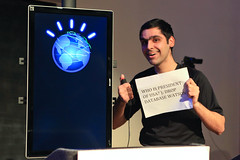
IBM Watson (Jeopardy at Carnegie Mellon) - How...
IBM Watson (Jeopardy at Carnegie Mellon) - How I saved humanity! (Photo credit: Anirudh Koul)
Designed and built by IBM, Watson was designed to answer questions on the TV game show Jeopardy.  Unlike Deep Blue, Watson could not only understand the sometimes arcane questions posed on the show, but it could deliver its answers verbally. Relying on an extensive database of some 200 million pages of content contained in four terabytes of RAM, Watson competed on the air against two of the most successful human Jeopardy competitors of all time, Ken Jennings and Brad Rutter, beating them both for a prize worth one million dollars. 

Since DeepBlue's victory over Garry Kasparov in chess in 1997, IBM had been on the hunt for a new challenge. In 2004, IBM Research manager Charles Lickel, over dinner with coworkers, noticed that the restaurant they were in had fallen silent. He soon discovered the cause of this evening hiatus: Ken Jennings, who was then in the middle of his successful 74-game run on Jeopardy!. Nearly the entire restaurant had 
Watson, Ken Jennings, and Brad Rutter in their...
Watson, Ken Jennings, and Brad Rutter in their Jeopardy! exhibition match. (Photo credit: Wikipedia)
piled toward the televisions, mid-meal, to watch the phenomenon. Intrigued by the quiz show as a possible challenge for IBM, Lickel passed the idea on, and in 2005, IBM Research executive Paul Horn backed Lickel up, pushing for someone in his department to take up the challenge of playing Jeopardy! with an IBM system.  Eventually David Ferrucci took him up on the offer.
In initial tests run during 2006, Watson was given 500 clues from past Jeopardy programs. While the best real-life competitors buzzed in half the time and responded correctly to as many as 95% of clues, Watson's first pass could get only about 15% correct. During 2007, the IBM team was given three to five years and a staff of 15 people to solve the problems. By 2008, the developers had advanced Watson such that it could compete with Jeopardy! champions.  By February 2010, Watson could beat human Jeopardy! contestants on a regular basis”
Can you say Doctor Watson?

More incredibly, after retiring from television, Watson was repurposed in 2013 to provide management decisions in lung cancer treatment at Memorial Sloan-Kettering Center.  IBM Watson’s business chief Manoj Saxena says that 90% of nurses in the field who use Watson now follow its guidance.  IBM is also looking at the possibility of using Watson for legal research,

While the software that upon Watson is based is available to large corporations and research centers
Deep Blue
Deep Blue (Photo credit: James the photographer)
According to IBM, "The goal is to have computers start to interact in natural human terms across a range of applications and processes, understanding the questions that humans ask and providing answers that humans can understand and justify."  (such as Rensselaer Polytechnic Institute) The rub is that a system that meets the minimum requirements necessary to run a program as sophisticated as Watson currently costs more than one million dollars.  However, as computer chips become faster and less costly, it won’t be long before this kind of technology makes it to the masses.  When you realize that the computer power available in today’s smartphones is superior to that used to fly the Space Shuttle, then this claim is hardly beyond the realm of possibility.  (Even a handful of top executives at Google has espoused the goal of creating a computer much like the one on the series Star Trek.)
The Moore the Merrier
The real driving force behind the race to build intelligent computers did indeed start back in the 1960's with a tenet called Moore's Law.  Moore’s Law states that computer power doubles approximately every two years.  This little gem was coined by Intel co-founder Gordon Moore back in 1965, when he published a paper noting that the number of components in integrated circuits had doubled ever since their invention in 1958.  While this trend has slowed slightly over the intervening forty eight years, the nearly exponential growth of computing power has directly impacted every aspect of the electronics industry and brought us closer to the point where computers will be able to think for themselves.  It also led to other technological visionaries taking the next logical step.
Peter Van DerMade, former IBM chief scientist, has spent over a decade studying the human brain and understanding how to replicate it in computer form. His new book, Higher Intelligence, tells the story of a 10-year breakthrough R&D project to build an 'artificial brain' chip that will help computers learn much like the human brain.  "By producing computer chips that allow computers to learn for themselves, we have unlocked the next generation of computers and artificial intelligence," Mr Van Der Made says.  “We are on the brink of a revolution now where the computers of tomorrow will be built to do more than we ever imagined.  Current computers are great tools for number crunching, statistical analysis, or surfing the Internet. But their usefulness is limited when it comes to being able to think for themselves and develop new skills," he says.“The synthetic brain chip of tomorrow can evolve through learning, rather than being programmed.”

Peter goes onto say in his book that he and his colleagues have already been able to simulate many of the functions of the human brain and convert them into hardware and software that enables computers to "learn new skills" without the intervention of programmers.  If he is correct, the next few years could see a paradigm shift that is more earth shattering than that of the advent of the silicon chip. Already we are seeing autonomous aerial vehicles flying the friendly skies and driverless automobiles plying the highways of Southern California.  With a few more iterations of Moore’s Law and a bit of tinkering, will we shortly be on the verge of intelligent systems, everyday robotics and machines that can outthink their makers?

If this isn’t quite the case yet, all I can say is, “Let’s come up with a game…”

Carl Weiss is president of W Squared Media Group, a cutting edge digital marketing agency in Jacksonville, Florida.  You can also interact live with Carl every Tuesday at 4 pm Eastern on his radio show, Working the Web to Win 


Enhanced by Zemanta