Showing posts with label Steve Jobs. Show all posts

Steve Jobs: The Ghost in the Machine?

By Carl Weiss

Image courtesy of setupsandspaces.com
At Apple Computer, Steve Jobs is gone but not forgotten.  While it would be hard to forget their iconic cofounder, even 3 years after his death, it is as though Steve had just stepped out for lunch.  That’s due in part to the fact that Jobs had his hand in so much of what we consider to be high tech today.  He was one of the architects in all kinds of technology, from the personal computer, to the tablet and smartphone.  If you buy music online, iTunes pioneered the way that the industry sells digital music.  If you enjoy animated motion pictures, let’s not forget that Steve was the knight in shining armor who came to the rescue of Pixar when even the likes of George Lucas was unable to afford to keep it afloat in the early days of digital cinema.

Of course, there is one other reason why anyone who visits Apple Computer corporate headquarters at 1 Infinite Loop, Cupertino, California would have the impression that Steve is due back at any moment. That’s due to the fact that his office has remained virtually untouched since his departure.  His nameplate still graces the door.  When asked why during a March 18, Washington Post interview, Apple CEO Tim Cook responded,

I haven’t decided about what we’ll do there. But I wanted to keep his office exactly like it was. What we’ll do over time, I don’t know. I didn’t want to move in there. I think he’s an irreplaceable person and so it didn’t feel right . . . for anything to go on in that office. So his computer is still in there as it was, his desk is still in there as it was, he’s got a bunch of books in there. His name should still be on the door. That’s just the way it should be. That’s what felt right to me.”
That could change in a year, when Apple’s new flying saucer-shaped headquarters is completed.  But what will not change is the large footprint and lasting legacy of one of the titans of microcomputing.  In their just released book, “Becoming Steve Jobs: The Evolution of a Reckless Upstart into a Visionary Leader," authors Brent Schlender and Rick Tetzeli document Jobs’ triumphs and travails. While a visionary, Steve had what amounted to blinders on in a number of circumstances that cost him big.

Image courtesy of fastcodesign.com


One of the first was a unilateral decision he made in 1984 to air an Orwellian 60-second spot during the Super Bowl without consulting the board until the day before it was scheduled to air.  According to the book, the board was so horrified that they sold one of their spots so that the ad only appeared once during the game.


Shortly after that, Steve decided it was time to reinvent the personal computer, the market for which was becoming glutted since the introduction of the IBM PC and its many clones.  Taking $50 million of the company’s money, Steve assembled a team of the best and brightest at Apple and created what he thought would be the next leap forward in personal computing technology.  Called Lisa, the computer was released in January of 1984 priced between $3,495 and $5,495. Even though the system was well ahead of its time, commercially its launch was hailed as a failure, one that would ultimately cost Jobs his job.  

Courtesy of en.wikipedia.org
This failure did not deter Jobs, who along with several other ousted Apple employees went onto start NeXT Computer, Inc. in 1995.  While NeXT only sold around 50,000 units and was ultimately absorbed by Apple for $429 million, several of the concepts developed at NeXT were incorporated into later Apple systems, including parts of the OS X and IOS operating systems.  During his hiatus from Apple, Steve Jobs also dabbled with another company called Pixar, in which even George Lucas had lost faith.  Pixar would later go onto produce a number of animated features some of which would receive Academy awards.  Jobs also clearly had a bead on the NeXT big trend of the 1990’s which he referred to as interpersonal computing that would soon appear with an eerily similar moniker: The Internet. 

While Steve Jobs returned to Apple, after running another computer company he started called NeXT, a man named Gil Amelio was the CEO of Apple. The company was a disaster at this point, and Jobs didn't think very highly of him — in fact, he thought he was a bozo.  
To signal his displeasure, Jobs dumped all but one of the shares he had gotten for selling NeXT to Apple without telling anyone. He had one share, so he was still able to attend Apple's annual meeting, "but the sale was a high-decibel vote of no confidence," write the authors. "Amelio felt stabbed in the back, as he was."        
More importantly, immediately upon his return as CEO, Steve’s first job was to replace nearly everyone on Apple’s board.  You have to remember that Steve was absent from Apple for eleven years, during which time the company had floundered.  Within two years Jobs had brought Apple back from the brink of near bankruptcy.  In 1998, Steve started debuting a number of revolutionary new products, including the   iMac,  iPod, iPhone, and iPadHe also initiated the service side of the business by opening a chain of Apple Retail Stores and two new etailers,  iTunes Store and the App StoreAs a result, by 2011 Apple became the world’s most valuable publicly traded companies.
Unfortunately, that was also the last year of Steve Jobs life.  That doesn’t mean he waited until the last minute to make sure that his legacy was preserved. 
"Steve cared deeply about the why," current Apple CEO Tim Cook told authors Brent Schlender and Rick Tetzelii. "The why of the decision. In the younger days I would see him just do something. But as the days went on he would spend more time with me and with other people explaining why he thought or did something, or why he looked at something in a certain way. This was why he came up with Apple U., so we could train and educate the next generation of leaders by teaching them all we had been through, and how we had made the terrible decisions we made and also how we made the really good ones.
Apple's senior vice president of Internet Software and Services, Eddy Cue, noted that Jobs was "working his ass off till the end, in pain," using morphine to remain functional. In his final years Jobs began accelerating preparations to leave the company in a good shape, including founding Apple University, but also talking with Cook about what would happen after his death.

"He didn't want us asking, 'What would Steve do?' He abhorred the way the Disney culture stagnated after Walt Disney's death, and he was determined for that not to happen at Apple," according to Cook."
Summoning Tim Cook to his home on August 11, 2011, Steve passed him the torch by naming Tim as his successor.  But even that meeting demonstrated Jobs unwillingness to give up the ghost.
“Cook remarked to the biography's authors.  "I thought then that he thought he was going to live a lot longer when he said this, because we got into a whole level of discussion about what would it mean for me to be CEO with him as a chairman. I asked him, 'What do you really not want to do that you're doing?'"

While his passing did have a short term negative impact on Apple’s stock price that briefly fell 5%,
Courtesy of extremetech.com
the company Steve founded is today stronger than ever. In March 2011, Fortune Magazine named Steve Jobs the “greatest entrepreneur of our time.”  Other posthumous honors included the Grammy Trustees Award, inducted as a Disney Legend, along with a bronze statue in Budapest commissioned by the Graphisoft company and a memorial that was erected in 2013 in St. Petersburg, Russia.
Suffice it to say while the corporeal form of Steve Jobs will only be with us via YouTube and previously televised interviews, his undying spirit and lifelong list of  technological accomplishments will continue to haunt the industry that he helped spawn. 


The Smartest Guys in the Room

By Carl Weiss

When it comes to revolutionizing the way in which we perceive and operate in the world as we know it, the Internet has without a doubt been one of the most important inventions ever created.  And like many inventions, the web was the result of a lot of labor by a number of talented people.  Some of those people wound up being relegated to footnote status while others went onto become Internet icons.

The Internet was actually an outgrowth of the ARPANET, which was a cold war project designed to safeguard government communications in case of nuclear attack by the Soviet Union.  Developed in the sixties and seventies, the ARPANET program led to t a number of internet protocols such as TCP/IP that formed the foundation for internetworking that we all use today.

wozniak_jobs
wozniak_jobs (Photo credit: Revolweb)
The only problem was that back in the sixties and through much of the seventies, the only people who had access to computers were governments, fortune 500 companies and universities.  Then in 1976 a couple of guys named Steve invented and began selling one of the first practical microcomputers, called the Apple.  The problem back then was that these fledgling computers were not very powerful and they were expensive.  The first Apple sold for $666.66.  This was at a time when many compact cars sold for a couple thousand dollars.

Add to this the fact that their computer didn’t do a lot and it was obvious that they would have to woo a number of software developers.  Some of these included Fred Gibbons, Mitch Kapor and Bill Gates.  While people think of Microsoft as being a mortal enemy of Apple, back then the two were kissing cousins.  It wasn’t until a few years later with the advent of the IBM PC that the lines were drawn in the sand between Apple vs PC and the two wound up in opposing camps.  In the early days not only did every Apple computer come equipped with Gate’s version of Basic, but in a 1983 interview Bill  stated that he expected to generate half of Microsoft’s revenues in 1984 from Macintosh software alone.

While many people don’t instantly recall who Fred Gibbons and Mitch Kapor were back then, their contributions kept Apple’s train on the tracks during the early half of the eighties.  Fred’s company Software Publishing Company created a number of software products, chief among them being Harvard Graphics, which brought on-screen graphics capabilities to early versions of the Apple. 

Mitch Kapor developer of Lotus 1-2-3 was one of the rock stars of software development in the early days of personal computing.  In fact Lotus 1-2-3 became one of microcomputing’s first killer apps which would eventually contribute to the popularity of Apple’s nemesis, the IBM PC.  That doesn’t mean that there weren’t other software developers on the hunt for other killer apps.  In fact, Lotus 1-2-3 was an offshoot of another earlier spreadsheet program called Visicalc. 

Of course, competition among software developers was not the only place where the microcomputer war was heating up.  Back then there were a number of companies trying to muscle in on the hardware game as well.  Chief among them was Tandy Radio Shack whose TRS-80 was a popular brand at the time.   (Although it didn’t help that denigrators of the brand used to refer to it as the Trash Eighty.)  The Commodore 64 was another successful brand, selling some 17 million units sold. 

The first developers of IBM PC computers negle...
The first developers of IBM PC computers neglected audio capabilities (first IBM model, 1981). (Photo credit: Wikipedia)
This is when the titan of computer manufacturing decided to get into the game with a micro of its own.  By 1980 more than 50 microcomputer systems were on the market.  This is when IBM decided it was time to join the fray.  Before 1981, IBM was the dominant player when it came to mainframe computers.  They had never even considered creating a microcomputer.  In fact, so sudden was their entry into this burgeoning market that they did something unprecedented.  Instead of taking the time to create an entirely proprietary product, they instead cobbled together the IBM PC with mostly off-the-shelf technology.  (They didn’t even have an operating system for a PC, which opened the door for Bill Gates whose MS-DOS system quickly became the defacto operating system for the IBM PC along with an eventual swarm of clones.)

So many competitors began to pile on that even those who had enjoyed hegemony during the early going (such as Apple) began to feel the heat.  By 1982, the marketplace had reached critical mass and a shakeout was inevitable.  Not wanting to wind up kicked to the curb, Steve Jobs at Apple decided it was time to reinvent itself by once again looking into the crystal ball to determine where personal computing was headed.  So taking $50 million of the company’s money, Steve assembled a team of the best and brightest at Apple and created what he thought would be the next leap forward in personal computing technology.  Called Lisa, the computer was released in January of 1984 priced between $3,495 and $5,495Even though the system was well ahead of its time, commercially its launch was hailed as a failure, one that would ultimately cost Jobs his job. (The release later that year of the Macintosh, which was both faster and cheaper saved Apple from joining the technological scrap heap wherein many of its competitors wound up.)

Image representing NeXT as depicted in CrunchBase
This failure did not deter Jobs, who along with several other ousted Apple employees went onto start NeXT Computer, Inc. in 1995.  While NeXT only sold around 50,000 units and was ultimately absorbed by Apple for $429 million, several of the concepts developed at NeXT were incorporated into later Apple systems, including parts of the OS X and IOS operating systems.  During his hiatus from Apple, Steve Jobs also dabbled with another company called Pixar, in which even George Lucas had lost faith.  Pixar would later go onto produce a number of animated features some of which would receive Academy awards.  Jobs also clearly had a bead on the NeXT big trend of the 1990’s which he referred to as interpersonal computing that would soon appear with an eerily similar moniker: The Internet. 

The term Internet was actually coined back in 1974 as an abbreviation to the term “internetworking”.  Of course, at that time, the only entities internetworking were military sites and universities.  However, by the 1980’s NASA joined the fray by developing the NASA Science Network which allowed scientists to share data on a global basis.  This eventually coalesced into the NASA Science Internet, which eventually connected more than 20,000 scientists worldwide.  As interest in worldwide networking grew, the technology spawned other early adopters, such as Usenet, UUCPNet, FidoNet, JUNET and NSFNET.   During the late 1980’s the first Internet service providers were formed, starting with the first commercial dialup service in the US called The World.

By the early 1990’s search engines such as Archie and Gopher sprung up, along with the first web browsers, such as ViolaWWW.  While a far cry from the multi-media offerings we have come to know and expect today, these early search engines and browsers offered little more than text-only listings more reminiscent of Craigslist than Google.  That did not mean that there wasn’t market share to be had. 

As the World Wide Web grew, search engines and web directories began to spring up like weeds with such names as WebCrawler, Lycos, HotBot, Excite, Yahoo (founded in 1994) and AltaVista.  Also several new web browsers hit the market, the most notable of which was Netscape, that appeared in 1994.  Clearly a cut above other web browsers, Netscape Navigator was the gold standard for surfing the web in the 1990’s.  In fact the product was such a hit that only 16 months after its inception, the company went public with its stock soaring from $28 to $58 on the opening day.  It also began the feeding frenzy later called the Tech Bubble that would run rampant for the next six years creating a number of billionaires in the process.

Bill Gates
One such billionaire definitely took notice of Netscape in a big way.  Bill Gates at Microsoft knew a good thing when he saw it.  And he knew that Microsoft had to stake a claim on the Internet.  By August of 1995 Microsoft announced the introduction of Internet Explorer 1.0.  While it took Microsoft more than 5 years to gain the upper hand over Netscape, their dominance in the operating system market opened the doors for them to chip away at Netscape’s market share.  So much so that by June of 2006 netscape.com went dark for good.  That would seem like good news to Bill at Microsoft.  It probably would have been had it not been for one other upstart named Google.

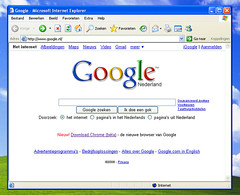
Begun in March of 1996 as a research project by two Stanford students named Larry Page and Sergey Brin, their original idea had not been to design a web browser or search engine for that matter.  What they were out to develop was the world’s first digital library.  In search of a dissertation theme, Page considered exploring the mathematical properties of the Internet by turning its structure into a gigantic graph.  Page’s web crawling software called BackRub began exploring the web autonomously with Page’s own website serving as ground zero.  His research along Brin’s help eventually morphed into an algorithm that the pair named PageRank, which became the nexus for their Google search engine, which was registered on September 15, 1997.

Google Chrome
Google Chrome (Photo credit: thms.nl)
By December 1998, Google had an index of about 60 million pages.  But already a number of Internet gurus were arguing that Google’s search results were superior to those of its competitors.  In March 1999 the company moved to Palo Alto.  In June of that same year they secured $25 million in equity capital from venture capital firms Kleiner Perkins Caulfield and Sequoia Capital.  While Brin and Page were hesitant to take the company public, it was Google’s IPO on August 19, 2004 that shook the pillars of the Internet that would ultimately see Google as not only the dominant search engine online, but it would also enable the company to own the world’s most popular web browser (Chrome), the world’s most popular video portal (YouTube) and the world’s most popular cellphone operating system (Android).

Of course, like a many innovators that came before them, that doesn’t mean that the latest successors to the Internet crown are always omniscient.  Several of Google’s latest tech forays have yet to come to roost, including a computer worn on your face (Google Glass), a pair of mysterious barges berthed in San Francisco Bay and Maine, and communication blimps that are designed to bring the Internet to sub- Saharan Africa.

Not to be outdone, Apple announced a product a year ago that while intriguing has yet to hit the market called the iWatch.  Love them or hate them, one thing you can say about the smartest guys in the room is that they will never leave you bored.  I can’t wait to see what comes NeXT.

Carl Weiss is president of W Squared Media Group, a digital media agency located in Jacksonville, Florida.  He is also co-host of Working the Web To Win that is broadcast on BlogTalkRadio and YouTube every Tuesday at 4 pm Eastern.


Enhanced by Zemanta